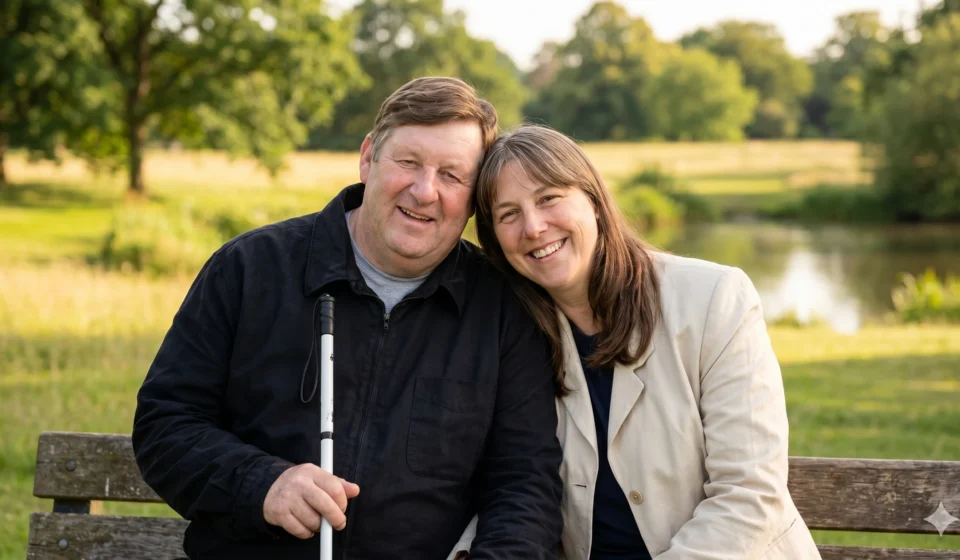

Gary O’Donoghue’s voice has carried across some of the most tense moments in recent political history, from Westminster power shifts to Donald Trump rallies and the turbulence of American public life. Yet one of the most common searches about him is not about a broadcast, a scoop, or his career as one of the BBC’s best-known blind journalists. It is about Gary O’Donoghue wife, a query that leads to Sarah Lewthwaite, the woman linked to his private life for many years. Her story is not a celebrity spouse narrative, and that is exactly why it needs careful handling.
The verified public record identifies Sarah Lewthwaite as O’Donoghue’s long-term partner and, in later reporting, his wife. She has been described as a fellow BBC journalist, but she has not built a public profile around his career or made herself a regular subject of interviews. The result is a family story that sits quietly beside a very visible professional life. For readers, the useful answer is not a pile of guessed-at personal details, but a clear account of what is known, what is not confirmed, and why that distinction matters.
Who Is Gary O’Donoghue’s Wife?
Sarah Lewthwaite is publicly known as the long-term partner of Gary O’Donoghue and has been referred to in some later coverage as his wife. In a 2009 profile, The Independent described O’Donoghue as living in Yorkshire with his partner, Sarah Lewthwaite, and their daughter, Lucy. In 2024, The Guardian described Lewthwaite as his wife and a fellow BBC journalist. Those two descriptions are not necessarily in conflict, but they do show why careful wording is needed.
There is no widely available public wedding date, marriage announcement, or detailed personal biography for Lewthwaite. That means any article claiming a full marriage timeline without a reliable source should be treated with caution. What can be said confidently is that Lewthwaite has been part of O’Donoghue’s family life for many years. She is also the mother of his daughter, Lucy, whose name appeared in earlier mainstream reporting.
Lewthwaite’s low public profile is one of the defining facts about her. She is not a celebrity in her own right, and she does not appear to have used O’Donoghue’s visibility to attract attention. Most references to her appear only in stories about him, usually to give family context. That makes this biography less about public performance and more about the boundaries of private life around a public journalist.
Sarah Lewthwaite’s Public Profile
The public information about Sarah Lewthwaite is limited, and a responsible biography has to begin there. She has been identified by The Guardian as a fellow BBC journalist, but reliable public sources do not provide a detailed career chronology. Her age, early life, education, and family background are not confirmed in mainstream reporting. Claims about those subjects appear on lower-quality biography sites, but many are thinly sourced or impossible to verify.
That absence of detail can frustrate readers who arrive expecting a standard public biography. Still, it also tells us something meaningful about how Lewthwaite has handled attention. She has not become a regular media presence, has not shaped a public persona through interviews, and has not turned family association into a brand. In an age when even private people are often pushed into visibility, that restraint is striking.
A careful profile of Lewthwaite should not pretend to know more than the evidence allows. It can say she is connected to the BBC world through reporting that describes her as a journalist. It can say she has shared a long family life with O’Donoghue and their daughter. It should not invent an origin story, a private career path, or a set of personal views that she has not publicly offered.
Marriage, Partnership, and the Question of Wording
The phrase “Gary O’Donoghue wife” suggests a simple answer, but the sourcing is slightly more complicated. The Independent used the word “partner” in 2009, while later coverage used “wife.” That shift may reflect a marriage after the earlier profile, a shorthand used by later writers, or simply the way long-term relationships are sometimes described across time. Without direct confirmation, the exact legal status and wedding date should not be overstated.
This is where many online biographies go wrong. They turn “partner” into a full wedding story or present unsourced details as if they are public record. A stronger account respects the distinction between what readers want to know and what reporting can prove. Sarah Lewthwaite is clearly part of O’Donoghue’s long-term family life, but the formal details of their relationship have not been fully documented in public.
The safest description is also the most accurate: Sarah Lewthwaite is Gary O’Donoghue’s long-term partner and has been described in reliable reporting as his wife. That phrasing answers the search while leaving room for the limits of the record. It also avoids the false certainty that often surrounds private family information. For a journalist’s family, that kind of care is not a technicality; it is the standard the subject himself would likely expect from good reporting.
Family Life and Their Daughter Lucy
Gary O’Donoghue and Sarah Lewthwaite have one daughter, Lucy. The Independent named Lucy in its 2009 profile, when she was described as seven years old and living with her parents in Yorkshire. That detail places the family’s private life in a specific setting, away from the London and Washington newsrooms most associated with O’Donoghue’s work. It also shows how long Lewthwaite has been present in the story of his adult life.
Yorkshire appears repeatedly in public references to the family. O’Donoghue has spent major stretches of his career in London and Washington, but earlier reporting described him dividing time between work and home. More recent coverage has suggested that his job in the United States has created the familiar strains of distance for a correspondent with family ties in Britain. That tension gives a more realistic picture than the tidy idea of a journalist’s life as constant travel and professional adventure.
Lucy, like her mother, has remained private. There is no strong public record of her adult life, and there is no good reason for a biography to push beyond the facts already reported. The important point is not to make her a subject of attention, but to understand the family frame around O’Donoghue. His career has unfolded alongside a home life that has remained intentionally guarded.
Gary O’Donoghue’s Early Life
Gary O’Donoghue was born in London in 1968 and became blind by the age of eight. He was born with serious sight problems, had one eye removed as a baby, and later lost vision in the other after a childhood accident. In later interviews, he has spoken with unusual directness about the emotional toll this placed on his parents. His mother, who taught ballroom dancing, once told him that during his childhood she had considered killing them both because she felt so desperate and unsupported.
That memory is difficult, but O’Donoghue has treated it with compassion rather than bitterness. He has said he was moved by his mother’s courage in telling him the truth because it helped him understand how alone she and his father must have felt. Britain in the 1970s offered far less support to families of disabled children than it does now. His childhood story is therefore not only personal; it is also a reminder of how disability was often handled privately, painfully, and with too little help.
O’Donoghue attended Worcester College for the Blind, then a specialist boarding school for boys. He has described aspects of that education as tough, but also formative. He played blind football for England and learned early how to navigate institutions that were not built around ease. That experience later shaped the resilience and sharp listening skills that became central to his journalism.
Education and First Steps Into Journalism
After school, O’Donoghue studied philosophy and modern languages at Christ Church, Oxford. That academic background suited a future political reporter: it demanded argument, precision, language, and the ability to follow complicated ideas under pressure. Oxford also placed him in a world where ambition was normal and public life was close at hand. It did not make his career easy, but it gave him the tools to compete in serious journalism.
He joined the BBC after university and began on Radio 4’s Today programme. Radio was a natural fit for a journalist whose ear was already highly trained, but O’Donoghue did not limit himself to audio work. Over time, he reported across radio, television, and digital formats, covering stories in Africa, Asia, Europe, Britain, and the United States. His career became a quiet challenge to lazy assumptions about what blind journalists could or could not do.
The early years also tested him in ways that were not always visible to audiences. He had to deal not only with the ordinary pressure of BBC journalism, but also with doubts from others about whether a blind reporter could handle television news. O’Donoghue has spoken about discrimination and the extra effort required to prove himself. His success did not come because institutions were generous; it came because he kept forcing space open.
Career Breakthrough at the BBC
O’Donoghue became a Westminster-based political correspondent in 2004, a period when British politics was entering years of strain and transition. Tony Blair was still prime minister, the Iraq War shaped political debate, and the Labour government was moving toward the handover to Gordon Brown. Westminster reporting rewards speed, judgment, and source-building. O’Donoghue earned a place in that world through persistence and accuracy.
In 2007, he broke the story that Gordon Brown was returning early from holiday during the foot-and-mouth disease outbreak in Surrey. The scoop became part of a later dispute after O’Donoghue was taken off the television report and replaced by a sighted journalist. The matter ended with an out-of-court settlement from the BBC on disability discrimination grounds. It remains one of the clearest public examples of the barriers he faced inside the industry he had already proved he could serve.
That episode did not end his BBC career. In 2011, he became chief political correspondent for BBC Radio 4, taking on one of the most respected jobs in British broadcast journalism. The role put him close to the daily machinery of British politics and the programmes that shape the national news agenda. By then, O’Donoghue was no longer an exception who needed explaining; he was one of the corporation’s serious political reporters.
Moving to Washington and Covering America
In 2014, O’Donoghue moved to Washington, D.C., as the BBC’s chief North America political correspondent. The timing placed him in the path of a political era that would become unusually volatile. He covered the end of Barack Obama’s presidency, Donald Trump’s 2016 campaign and first term, Joe Biden’s presidency, and the bitter conflicts surrounding the 2020 and 2024 elections. For British audiences, he became one of the voices explaining America at moments when America often seemed difficult to explain.
The Washington role changed the scale of his work. He reported on presidential campaigns, the White House, Congress, gun violence, social division, court cases, and moments of national crisis. He also covered several major mass shootings, a recurring part of American life that he has discussed with evident frustration and concern. His reporting combined political analysis with the practical demands of being present where events were unfolding fast.
In March 2025, BBC News announced that O’Donoghue would become its Chief North America Correspondent. The appointment confirmed his place among the broadcaster’s senior international reporters. It also came after a decade in which he had become closely associated with the BBC’s coverage of U.S. politics. By that point, his career was no longer simply a story of overcoming disability; it was a record of sustained authority on one of the world’s biggest beats.
The Trump Rally Shooting and a Wider Public Profile
O’Donoghue gained wider public attention after the attempted assassination of Donald Trump at a rally in Butler, Pennsylvania, on July 13, 2024. He was reporting from the event when gunshots rang out and Trump was rushed from the stage. O’Donoghue later described recognising the sound of gunfire and realising that Trump had stopped speaking. It was one of those moments when a reporter’s instincts, calm, and field experience matter more than any studio polish.
His interview with eyewitness Greg Smith became especially important. Smith said he had seen a gunman on a roof before shots were fired, raising early questions about security failures. O’Donoghue later said his blindness may have helped him focus on what Smith was saying rather than how he looked. That comment captured something central about his work: he does not treat blindness as a sentimental footnote, but as part of the way he gathers information.
The interview was widely discussed because it moved the story forward in real time. It also introduced O’Donoghue to audiences who may not have followed BBC political coverage closely before. For many, the moment became a powerful example of field reporting under pressure. For those already familiar with his career, it was consistent with a long pattern: listen closely, stay steady, and get the facts out.
Sarah Lewthwaite’s Place in His Public Story
Sarah Lewthwaite appears in O’Donoghue’s public story mainly at the edges, and that is part of what makes her presence distinct. She is not quoted often in profiles, does not seem to court coverage, and is not used as a promotional figure in his career. Yet her name appears at key points when writers describe the life behind the work. She is part of the domestic structure that has existed alongside decades of demanding journalism.
The life of a foreign correspondent can place heavy pressure on families. Washington assignments, campaign travel, breaking news, and live reporting leave little room for predictability. O’Donoghue’s work has taken him across time zones and into dangerous or emotionally draining situations. Against that backdrop, Lewthwaite’s privacy may be less a mystery than a form of steadiness.
It would be easy, but unfair, to write her as merely “supportive,” the stock phrase often applied to spouses of public figures. The truth is, the public record does not give enough material to describe her personality or private role in detail. What it does show is a long association, a shared daughter, and a life kept away from the machinery of media attention. That is enough to respect without turning restraint into myth.
Public Image, Disability, and Reputation
Gary O’Donoghue’s public image rests on three things: political authority, calm field reporting, and his role as a blind journalist in a visual medium. He has never allowed disability to be treated as the whole story, but he has also not hidden the discrimination and practical barriers he has faced. That balance has made him an important figure for disabled people who want representation without being reduced to inspiration. He is respected because he does the work, not because the work is framed as a novelty.
His comments about journalism and blindness often cut through easy assumptions. He has said that journalism depends heavily on listening, which can make the profession well suited to blind people. At the same time, he has been clear that the industry still creates unnecessary obstacles. The point is not that blindness magically helps or hurts in every setting, but that talent is often blocked by the expectations of others.
That reputation gives added weight to searches about his private life. Readers who admire his reporting naturally want to know more about the person beyond the screen. But the same respect that attaches to his professional story should extend to his family. Curiosity is understandable; intrusion is not.
Money, Salary, and Net Worth Claims
Searches about public figures often include money, and Gary O’Donoghue is no exception. Some celebrity biography sites publish estimated net worth figures for him, sometimes placing him around seven figures. Those numbers should be treated as estimates at best, because they are rarely backed by financial records, salary disclosures, or serious reporting. The BBC does publish pay information for some high-earning presenters and senior figures, but not every correspondent’s full income is publicly listed in a way that supports precise net worth claims.
What can be said is that O’Donoghue’s income sources are likely tied mainly to his long BBC career. He has held senior correspondent roles, reported internationally, and appeared across major BBC platforms. That kind of work can provide a stable professional income, but it does not automatically produce a verifiable public fortune. Without financial filings or direct disclosure, exact wealth claims are guesswork.
The same caution applies to Sarah Lewthwaite. Claims about her income, assets, or personal net worth are not supported by strong public evidence. If she has worked as a BBC journalist, as reported, that provides a professional context, not a public balance sheet. A responsible profile should resist turning private finances into searchable fiction.
What Gary O’Donoghue Is Doing Now
Gary O’Donoghue remains a senior BBC journalist focused on North America. His work centres on U.S. politics, the White House, elections, and major national stories with global consequences. Since being named Chief North America Correspondent in 2025, he has occupied one of the BBC’s most prominent international reporting roles. That position places him at the centre of coverage watched closely by audiences in Britain and beyond.
His recent public profile has also grown through long-form interviews and reflective appearances. In 2026, coverage of his appearance on Desert Island Discs drew attention to his childhood, his mother’s painful confession, and his experience of discrimination. The interview reminded audiences that the calm broadcaster on screen has lived through private and professional challenges that are far from abstract. It also showed that O’Donoghue is willing to speak plainly about disability, family strain, and the limits of institutional progress.
Sarah Lewthwaite’s current public activities remain largely private. There is no reliable recent public profile that gives a detailed account of her day-to-day life. She remains best understood through the limited facts available: a long-term partner or wife, a mother, and a person connected to journalism who has chosen not to become a public subject. That choice deserves to be part of the story, not treated as an obstacle to it.
Why the Search for Gary O’Donoghue Wife Keeps Growing
The search for Gary O’Donoghue wife has grown because his visibility has grown. Major political stories, live reporting from dangerous scenes, and his promotion within the BBC have made more people aware of him. Once a journalist becomes familiar to viewers, curiosity often shifts from the professional to the personal. Readers want to know who shares his life, where he comes from, and what kind of family stands behind the public role.
But here’s the thing: not every public figure’s family has a public story to tell. Sarah Lewthwaite has not presented herself as a public personality, and there is no substantial interview archive about her. That makes the strongest answer more modest than many readers expect. The article that best serves the search is the one that says clearly what is known and stops before invention begins.
There is also a broader reason this search matters. It shows how biography writing has changed in the search era, where a private spouse can become a keyword overnight. The challenge for journalists is to meet reader interest without turning uncertainty into content. In the case of Sarah Lewthwaite, restraint is not a lack of reporting; it is part of accurate reporting.
Frequently Asked Questions
Who is Gary O’Donoghue’s wife?
Gary O’Donoghue’s wife is widely identified as Sarah Lewthwaite. Earlier mainstream reporting described her as his partner, while later reporting has referred to her as his wife. The relationship itself is well established, but a public wedding date has not been clearly documented.
Is Sarah Lewthwaite a BBC journalist?
The Guardian has described Sarah Lewthwaite as a fellow BBC journalist. Reliable public sources do not provide a full account of her career history, current role, or professional timeline. For that reason, claims about her work should stay close to what has been reported.
Do Gary O’Donoghue and Sarah Lewthwaite have children?
Yes, they have a daughter named Lucy. The Independent named Lucy in a 2009 profile of O’Donoghue, when the family was described as living in Yorkshire. Lucy has remained a private person, and there is little reliable public information about her adult life.
Where does Gary O’Donoghue live with his family?
Public reporting has linked O’Donoghue’s family life to Yorkshire, while his BBC role is based heavily in Washington, D.C. Earlier profiles described him dividing his time between work and home, and later coverage has referred to the strain of distance. The most accurate answer is that his professional life is centred in the United States, while Yorkshire remains part of the family story.
When did Gary O’Donoghue marry Sarah Lewthwaite?
No reliable public source gives a confirmed wedding date for Gary O’Donoghue and Sarah Lewthwaite. Some sources use “partner,” while others use “wife,” which suggests either a change over time or different wording by reporters. Without direct confirmation, it is not accurate to invent a date.
What is Gary O’Donoghue’s net worth?
There is no verified public net worth for Gary O’Donoghue. Some biography websites publish estimates, but those figures are not supported by detailed financial evidence. His main known income source is his long BBC career, including senior roles covering British and American politics.
Why is there so little information about Sarah Lewthwaite?
Sarah Lewthwaite has kept a low public profile and has not made her private life part of O’Donoghue’s public career. Most reliable mentions of her appear only in profiles or reports about him. That limited record should be read as a privacy boundary rather than an invitation to speculate.
Conclusion
The story behind Gary O’Donoghue wife is, in the end, a story about the edge between public achievement and private life. Sarah Lewthwaite is not absent from the record, but she is present in a measured way. She is known as O’Donoghue’s long-term partner or wife, the mother of his daughter, and someone connected to journalism who has stayed largely outside the spotlight.
O’Donoghue’s own biography is full of public detail because his work has required public trust. He became blind as a child, built a serious BBC career, challenged discrimination, and reported through some of the most intense political moments of recent years. His life explains why people are curious, but it also shows why accuracy matters. A journalist’s family should not be turned into a guessing game.
What remains is a portrait shaped by contrast. O’Donoghue’s career is loud with history, deadlines, elections, gunshots, and live broadcasts. Lewthwaite’s public presence is quiet, restrained, and carefully held. Together, those facts offer a fuller and more respectful answer than any invented biography could provide.
The best way to understand Sarah Lewthwaite is not to force her into the role of public figure. It is to recognise her place in O’Donoghue’s life while accepting the limits of what has been shared. In a media culture that often rewards overexposure, that privacy may be the most revealing detail of all.