
Five-letter words look simple until you’re staring at three yellow tiles, two blank spaces, and a timer in your head. That’s why so many people search for “wordhippo 5 letter words”: they want a faster way to turn partial clues into real possibilities. WordHippo can help with Wordle, crosswords, Scrabble-style games, writing prompts, and vocabulary work, but only if you use it with care. This guide explains what the tool does well, where it falls short, and how to get cleaner answers without wasting time on weak guesses.
What WordHippo 5 Letter Words Means
Most people who search this phrase are looking for a word list, not a lesson in linguistics. They need words with exactly five letters, often filtered by a starting letter, ending letter, included letters, or excluded letters. WordHippo has pages built around those needs, including lists such as five-letter words starting with a certain letter and search tools for words containing specific letters. That makes it useful when your brain knows the pattern but can’t produce the word.
WordHippo itself is broader than a puzzle helper. Its main site includes a thesaurus, definitions, rhymes, translations, sentences, word forms, pronunciation tools, and word finders for games. The five-letter word pages sit inside that larger system, which is why the results can feel wider than a Wordle-only solver. You’re not just getting likely game answers; you’re getting entries from a broad word database.
That breadth is both the appeal and the problem. A crossword solver may welcome rare words, variant spellings, or specialist vocabulary. A Wordle player may not want those at all, especially if the goal is to find a likely daily answer. So the key question isn’t whether WordHippo works; it’s whether the result fits the job you’re asking it to do.
Why People Use WordHippo for Five-Letter Words
Wordle changed the way ordinary readers search for short words. The New York Times bought Wordle in 2022, after the game had already become a daily habit for millions of players. Its format is strict: one hidden five-letter word, six guesses, and color feedback after each attempt. That design made five-letter word search feel urgent, repeatable, and oddly personal.
Crosswords create a different kind of pressure. You might know that a clue means “angry,” that the answer has five letters, and that the third letter is “I.” A broad list can help, but a filtered word finder is much faster. WordHippo is especially handy when the clue could have several meanings and you need to scan possibilities.
Scrabble and Words With Friends players use five-letter lists for another reason. A five-letter word can open a board, use a difficult rack, or connect to existing tiles. But here’s the thing. A word can appear in a broad reference list and still fail under a specific game dictionary, so serious players should always confirm playability in the game’s accepted word source.
Writers and teachers use the same pages in a quieter way. A teacher may need five-letter spelling words for a worksheet. A songwriter may need a short word with a certain sound. A writer may want a punchier synonym that fits a tight headline or line. In those cases, WordHippo’s linked tools for synonyms, rhymes, and example sentences are often more useful than the raw list itself.
How WordHippo’s Five-Letter Word Tools Work
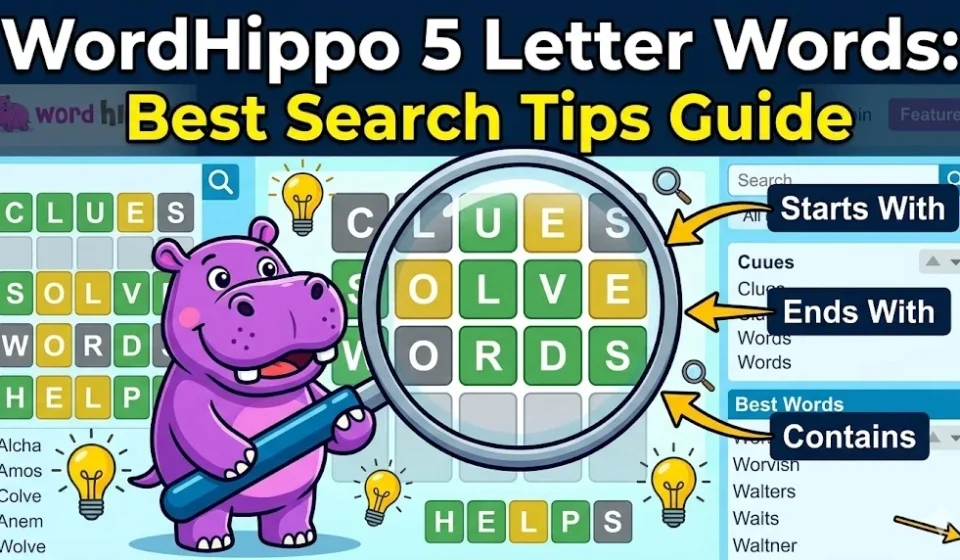
WordHippo’s word finder works best when you give it constraints. You can search by length, starting letters, ending letters, letters included in the word, and letters that should be excluded. The site also offers pages organized by prefixes, such as five-letter words starting with a specific letter. That structure matters because nobody wants to scan thousands of words when only twenty could fit.
Imagine you’re solving a Wordle-style puzzle and you know the word starts with “CR.” A general search for five-letter words would return far too much. A prefix search narrows the field immediately, and adding excluded letters cuts it down again. If you already know the word doesn’t contain “A,” “S,” or “T,” leaving those letters in the search is just making extra work for yourself.
There’s a catch, though. WordHippo’s results may include words that are real but not useful for your exact game. Some entries can be rare, regional, technical, archaic, or proper-name adjacent. That’s fine for a broad word reference, but it means you need to judge results before treating them as answers.
The best workflow is simple. Start with what you know, add what you’ve ruled out, and search narrowly. Then read the results like an editor, not a machine. If a word looks strange, check it before using it in a game or publishing it in a writing project.
Using WordHippo for Wordle Without Spoiling the Game
WordHippo is most useful in Wordle after your first or second guess. At that point, you usually have enough information to search intelligently. Green tiles give you fixed positions, yellow tiles give you included letters, and gray tiles give you exclusions. Put those clues together, and WordHippo can help you see words you might otherwise miss.
A common mistake is searching too broadly. If you know the second letter is “A” and the word contains “R,” don’t just browse all five-letter words. Search for five-letter patterns that match what you know, then exclude letters already ruled out. That turns a messy list into a smaller set of serious candidates.
Here’s what most people get wrong. WordHippo is not the official Wordle answer list. The New York Times now runs Wordle as part of its Games collection, and the daily answers are curated rather than pulled from every English word that happens to have five letters. A word may be accepted as a guess, appear in a reference list, or exist in English, but still be an unlikely answer.
That doesn’t make WordHippo useless for Wordle. It makes it a thinking aid. Use it when you’re stuck, when you want to study possible patterns, or when a letter combination feels impossible. If you want to preserve the puzzle’s challenge, avoid using it as a direct answer machine and use it only after you’ve made a serious attempt.
Using WordHippo for Crosswords, Scrabble, and Writing
Crossword solving rewards flexible thinking. A clue like “charge” could point to “blame,” “price,” “storm,” or “order,” depending on the puzzle. If you know the answer has five letters and a few crossing letters, WordHippo can help you test possibilities faster than memory alone. It’s especially useful when the clue’s meaning is clear but the exact word won’t come.
Scrabble-style play requires stricter checking. WordHippo can help you discover five-letter words from a rack, but it should not be your final authority for official play. Merriam-Webster’s Scrabble tools, for example, are designed around playable Scrabble words and wildcard searches. If points, rules, or competition matter, verify the word in the source your game uses.
Writing calls for a different standard again. A five-letter word that fits a puzzle may still sound awkward in a sentence. If you’re writing a headline, poem, slogan, worksheet, or short story, you need meaning, tone, and rhythm as much as length. WordHippo’s related tools can help because you can move from a five-letter word into synonyms, rhymes, and sentence examples.
A practical example helps. Suppose you need a five-letter word meaning “brave.” WordHippo might point you toward “bold,” but that’s four letters, while “brave” itself is five. From there, synonyms and examples help you decide whether “brave” is too plain, “daring” is too long, or another nearby word fits better. The tool gives options, but you still make the language choice.
Common Mistakes With WordHippo 5 Letter Words
The first mistake is treating every result as equally useful. WordHippo’s database is broad, so it may surface words that don’t belong in a casual puzzle or everyday sentence. Some entries may be technically valid but unfamiliar to most readers. If your audience won’t understand the word, or your game won’t accept it, the result has limited value.
Another mistake is ignoring letter position. Knowing that a word contains “E” is helpful, but knowing that “E” is not the second or fifth letter is much better. Wordle players often waste guesses because they track included letters but forget rejected positions. Good searching means recording both what worked and what failed.
People also forget that common and valid are different ideas. “Crane” is common and easy to recognize. A rare botanical or dialect word might be valid in some references but useless in Wordle or confusing in a classroom. That distinction matters more than most casual players realize.
Frankly, the best users are selective. They don’t ask WordHippo to think for them. They ask it to widen the field, then they cut the field back down with context. That’s the difference between getting help and getting noise.
How to Get Better Results Faster
Begin with the clearest clue. If the first two letters are fixed, search by prefix. If the last letter is fixed, search by ending. If you only know included letters, use the contains function and add exclusions as soon as you have them. A precise search is almost always faster than browsing.
For Wordle, write down your clues before searching. That sounds basic, but it prevents sloppy guesses. If “S,” “T,” and “L” are gray, they should not appear in your next candidate list. If “A” is yellow in the third spot, you need words with “A” somewhere else, not just any word containing “A.”
For crosswords, combine meaning with structure. Don’t search only by letters if the clue points strongly toward a definition. If the clue is “small songbird” and the answer is five letters, you’re not looking for every five-letter word with “R” in it. You’re looking for a bird that fits the crossings.
For writing, test the word in context. Read the sentence aloud. Check whether the word sounds natural for the audience. A five-letter match is not a good match if it makes the line stiff, vague, or misleading.
WordHippo Compared With Other Word Tools
WordHippo’s main advantage is range. A single site can take you from word length to synonyms, rhymes, definitions, translations, and sentence examples. That makes it more useful for general language work than a narrow puzzle solver. If you’re moving between games, writing, and vocabulary, that range saves time.
Dedicated Wordle solvers can be faster for one job. Many let you enter green, yellow, and gray letters in a game-like interface. They may also rank guesses by probability or commonness. But they usually don’t help much once you leave Wordle.
Scrabble tools have a similar edge for official play. They are better for checking validity, scores, and tile-based combinations. WordHippo can inspire possibilities, but a Scrabble-specific dictionary is safer when a word must count under formal rules.
So what does this actually mean? Use WordHippo as your broad language workbench. Use game-specific tools when the rules are strict. That simple split will save you from most bad results.
Frequently Asked Questions
What is WordHippo 5 letter words?
WordHippo 5 letter words refers to WordHippo pages and search tools that help users find words with exactly five letters. People use them for Wordle, crosswords, Scrabble-style games, writing, teaching, and vocabulary practice.
Is WordHippo good for Wordle?
Yes, WordHippo is useful for finding Wordle candidates, especially after you know some correct and incorrect letters. It isn’t the official Wordle answer list, so you should treat its results as possibilities rather than guaranteed answers.
Can WordHippo find five-letter words starting with a specific letter?
Yes, WordHippo has pages for five-letter words starting with specific letters and prefixes. That is often the fastest search method when the first letter or first few letters are already known.
Are all WordHippo five-letter words common words?
No, WordHippo may show uncommon, rare, technical, regional, or older words. That broad coverage is useful for discovery, but it can create weak guesses for Wordle or confusing choices for everyday writing.
Can I use WordHippo for Scrabble?
You can use WordHippo to find possible Scrabble words, but you should verify them in the official word source used by your game. A broad word list and an official playable-word list are not always the same thing.
What is the best way to search five-letter words on WordHippo?
The best method is to enter all known constraints, including length, starting letters, ending letters, included letters, and excluded letters. The more accurate your clues are, the cleaner your results will be.
Conclusion
WordHippo 5 letter words is popular because it solves a real problem quickly. You have a few letters, a fixed length, and a blank space your brain refuses to fill. A good word finder can break that deadlock.
Still, the tool works best when you bring judgment to it. Don’t treat every result as a final answer, and don’t confuse a broad word reference with a game-specific dictionary. The better habit is to search narrowly, check carefully, and choose the word that fits the context.
For Wordle, WordHippo can make you a sharper solver if you use it after thinking, not before. For crosswords and writing, it can surface words that memory misses. And for word games, it’s a strong starting point as long as you verify the rules.
The smartest use is simple: let WordHippo show you the field, then make the final call yourself. That’s how a five-letter search becomes more than a shortcut.