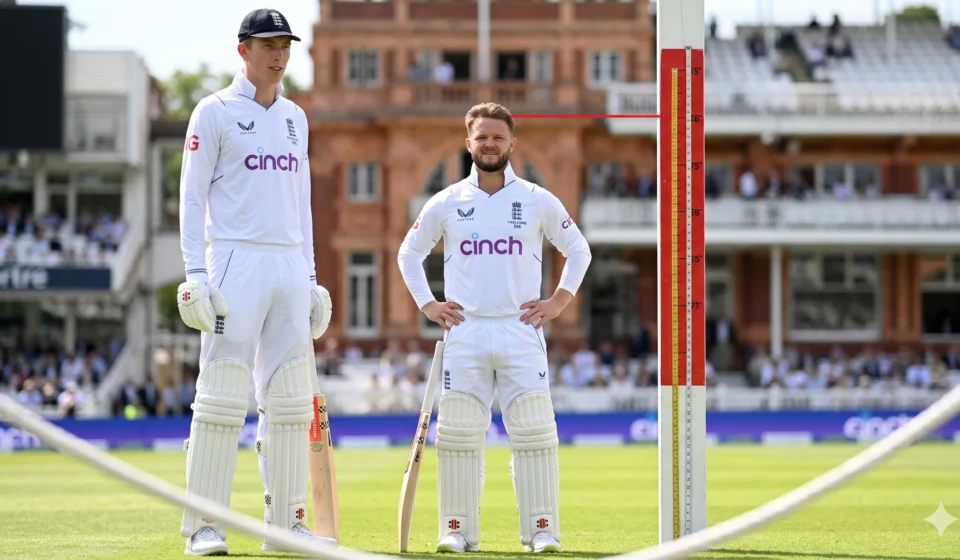

Ben Duckett has never looked like the tallest man in an England team photo, and that is part of why people keep asking about him. The England opener is widely listed at about 5 feet 7 inches, or 170 centimetres, a figure that stands out even more beside his 6ft 5in Test opening partner Zak Crawley. But Duckett’s height is only the starting point of a better story: how a compact, fast-scoring left-hander from Farnborough became one of the most watchable players in English cricket. His career has had promise, punishment, exile, reinvention, and a return that made his size feel less like a footnote than part of his cricketing identity.
How Tall Is Ben Duckett?
Ben Duckett’s height is most commonly given as 5ft 7in, or roughly 1.70 metres. The figure has appeared in major cricket coverage, including reporting that contrasted him with Zak Crawley in England’s “little and large” opening partnership. The Guardian described Duckett at 5ft 7in and Crawley at 6ft 5in, a 10-inch difference that has become part of the visual shorthand for England’s current top order.
That measurement matters because cricket is a game of angles, rhythm, and sightlines. Duckett’s lower stance and compact build shape the way bowlers see him, especially when he is paired with a much taller batter at the other end. He does not tower over attacks, but he hurries them, pulling their lengths forward and sideways through quick hands and early intent. The number may draw the search traffic, but the player behind it explains why the topic keeps coming up.
Early Life and Cricket Beginnings
Benjamin Matthew Duckett was born on 17 October 1994 in Farnborough, Kent, according to Nottinghamshire’s player history. He came through the Northamptonshire Cricket Academy from 2009 and was still studying for his A-levels at Stowe School when he made his county debut in a Twenty20 match against Gloucestershire in 2012. That early start placed him in a professional dressing room before most teenagers have worked out the shape of their adult life.
Stowe School, in Buckinghamshire, gave Duckett a sporting environment where cricket could move from talent to occupation. By 2013, he had made his first-class debut for Northamptonshire as an 18-year-old wicketkeeper-batter. ESPNcricinfo’s report from that debut noted his unbeaten 53 against Leicestershire, an innings that allowed Northants to set up a declaration and gave the county a glimpse of a player already comfortable with responsibility.
Those early years are easy to flatten into a neat success story, but Duckett’s development was not tidy. He was a gifted young batter with a strong academy background, yet he had to build the fitness, consistency, and judgement needed for senior cricket. The wicketkeeping part of his background mattered too, because it sharpened his reading of spin and angles. Even as his career moved toward full-time batting, that close-to-the-action education stayed in his game.
Northamptonshire Breakthrough
Duckett’s first major domestic surge came in the mid-2010s with Northamptonshire. Nottinghamshire’s own account records that by 2015 he had become a regular first-team player, scoring four County Championship hundreds and reaching 1,000 first-class runs for the season at an average of 52.73. That kind of county output made him difficult for England selectors to ignore.
The next year pushed him from promising county player to national prospect. In 2016, Duckett hit a career-best 282 not out against Sussex and kept adding heavy scores across formats. He also played a major part in Northants’ T20 Blast success, including a fast 84 in the semi-final and a place in the winning side.
Awards followed because the run volume was too large to dismiss. Duckett was named Young Cricketer of the Year by both the Cricket Writers’ Club and the Professional Cricketers’ Association at the end of the 2016 season. Those honours placed him among the best young players in the English game, but they also accelerated the pressure around him. He had become a name, and names in English cricket get tested quickly.
First England Chance and a Hard Lesson
Duckett made his England ODI debut against Bangladesh in October 2016 and his Test debut later that same month in Chittagong. ESPNcricinfo’s profile lists his ODI debut at Mirpur on 7 October 2016 and his Test debut at Chattogram on 20 October 2016, giving him a rapid entry into international cricket. The leap was steep because his first Test cricket came in Asian conditions, where spin, reverse swing, and game tempo can expose young batters fast.
His first England chapter did not last long. Duckett struggled during the 2016 tour of India and was dropped after two Tests, a common fate for young batters asked to learn in public. He had the talent, but the international game had asked harder questions than county cricket had prepared him to answer. That early setback became a useful reference point later, because his second England career would look far more settled than his first.
What stood out then was not only the scores but the sense that England had not yet found the right role for him. Duckett was a left-hander with attacking gifts, but he was not yet the finished opener he later became. He needed time, runs, and maturity, three things sport rarely gives patiently. The public saw a young batter drop out of the side; the fuller story was of a player still being built.
The 2017 Ashes Incident and Its Aftermath
Duckett’s most difficult public moment came during the 2017-18 Ashes tour period in Australia. While with the England Lions, he was disciplined after an incident in a Perth bar involving James Anderson. Sky Sports reported at the time that Duckett was fined and suspended by the ECB after allegedly pouring a drink over Anderson, and Cricbuzz reported that he received a final written warning and missed the remaining Lions games on the trip. +1
The incident followed Duckett for years because it fitted an easy but limiting label: talented, young, and not quite ready. Later, Duckett gave his own account of the episode, telling a different side of the story and saying it had been an extremely hard period in his career. ESPNcricinfo reported in 2024 that Duckett said Anderson had first thrown a drink over him and then encouraged him to return the gesture, though the punishment and public damage had fallen heavily on Duckett at the time.
The truth is, the episode mattered less for the drink than for what it interrupted. Duckett was already trying to fight back into England contention, and the disciplinary case pushed him further away from the senior side. He later spoke about maturing as a player and person, and The Times reported in 2025 that he saw a clear difference between the man he was in 2017 and the husband and father he had become.
Move to Nottinghamshire and Reinvention
Duckett moved from Northamptonshire to Nottinghamshire in 2018, a change that became more than a county transfer. The move gave him a fresh cricketing base at Trent Bridge, a ground with history, expectation, and a strong batting culture. Nottinghamshire’s profile frames his arrival as part of the next stage of a player who had already produced major county numbers but still had more to prove.
The years after the move helped reshape his career. He scored heavily in domestic cricket, widened his white-ball experience, and stayed close enough to England’s thinking to remain relevant. He also developed physically and mentally, with The Times reporting that he became “super-fit” during the Covid period and rebuilt his case through county runs.
That period matters because Duckett’s return was not based on nostalgia or one purple patch. It was built through repeated evidence that his attacking game could survive pressure and that he had learned from earlier failure. Cricket careers often turn on selection, but selection usually follows a quieter grind. Duckett’s comeback was earned in that quieter space.
England Return Under Stokes and McCullum
Duckett’s second England life began in a very different team environment. Under captain Ben Stokes and coach Brendon McCullum, England wanted batters who could attack, absorb risk, and change the rhythm of Test matches. Cricbuzz describes Duckett as a flamboyant left-handed opening batter whose real international initiation came after his 2022 return under England’s aggressive Test approach.
His recall for the Pakistan tour at the end of 2022 gave him the setting he needed. Duckett made a century in Rawalpindi and shared a 233-run opening stand with Zak Crawley, a partnership that announced England’s new-ball method in bold terms. The Guardian later pointed to that Pakistan series as the start of a more settled opening pair after years of churn following Andrew Strauss’s retirement.
This is where Duckett’s height became part of a cricketing picture rather than a trivia answer. Crawley’s height and reach offered one kind of problem for bowlers; Duckett’s compact, left-handed aggression offered another. Bowlers had to adjust line, length, angle, and release point from one end to the other. England did not just have two openers; they had two very different visual and technical challenges.
The Batting Style That Makes His Height Relevant
Duckett’s height helps explain how he plays, but it does not explain why he succeeds. At 5ft 7in, he naturally sets up closer to the ground than many openers, which can help his balance and access to square scoring areas. He is especially dangerous when bowlers give him width, because his hands move quickly and he rarely needs a large backlift to find pace off the bat. That compactness turns into pressure when he starts scoring before a bowler settles.
Against spin, Duckett’s wicketkeeping background and low base have long been useful. He sweeps, reverse-sweeps, and changes the field with the kind of confidence that can make defensive plans feel temporary. Against pace, his challenge is different: he has to judge bounce and length early while keeping his attacking instincts under control. The best version of Duckett does not ignore risk; it accepts risk as part of the method.
The Times described Duckett and Crawley as an “odd couple” who disrupt bowlers because of their different physical attributes and batting styles. The same report noted that Duckett’s strengths include sweeping and reverse-sweeping, especially in Asia, while Crawley has different strengths against pace. That contrast is not a gimmick; it is a practical reason the pair became valuable to England.
Career Milestones and England Standing
Duckett’s modern England record shows why he is no longer seen only as a comeback story. ESPNcricinfo’s current profile lists him with more than 3,000 Test runs, six Test hundreds, and international appearances across Tests, ODIs, and T20Is. Those figures place him among England’s established top-order players rather than fringe candidates waiting for another chance.
His highest Test score listed by ESPNcricinfo is 182, made during his second England phase, and his ODI record includes multiple hundreds. His white-ball game has travelled through domestic and franchise cricket as well, including The Hundred, the Big Bash League, the Pakistan Super League, and other competitions. The ECB lists him as an England player connected with Nottinghamshire and Birmingham Phoenix, reflecting both his county base and his franchise profile. +2Wikipedia+2
By 2023, England had rewarded Duckett’s consistency with a two-year central contract, according to Nottinghamshire. That contract mattered because it signalled institutional trust after years in which his place was far less secure. He had gone from a player associated with a stalled first chance to a core England batter. Few career arcs are more satisfying than a second chance that becomes a better version of the first.
Family, Marriage, and Private Life
Duckett’s private life has become more visible as his England career has grown, but he has not turned it into a public performance. Reports have linked him for several years with Paige Ogborne, and The Times reported in 2025 that Duckett had become a husband and father. Several cricket outlets reported that Duckett and Ogborne welcomed a daughter, Margot, in July 2024, after England Cricket publicly congratulated the couple. +1
Because much of the detail around cricketers’ partners comes from social media and lifestyle outlets, it should be handled carefully. Public reporting supports the broad facts that Duckett has a partner, became a father, and later married, but more intimate details about the relationship are not central to understanding his career. What does matter is that Duckett himself has framed family life as part of his maturity. The difference between the player disciplined in 2017 and the player speaking as a husband and father in 2025 is part of his public story.
That personal growth also changes how people read his cricket. A batter who once looked like a fast-tracked young talent now looks more settled in his own skin. That does not mean family life automatically improves performance, and it would be too neat to suggest it does. But Duckett has clearly presented adulthood, responsibility, and experience as part of the person he has become.
Money, Contracts, and Net Worth
There is no reliable public record of Ben Duckett’s exact net worth. Many celebrity-style websites publish estimates, but they often do not show sourcing and should not be treated as fact. A careful biography should avoid pretending that a private financial figure is known when it is not. What can be said with confidence is that Duckett’s income comes from England contracts, county cricket, domestic competitions, and franchise opportunities.
His two-year ECB central contract from 2023 would have been a major marker of financial and professional security. County cricket with Nottinghamshire, appearances in The Hundred, and overseas franchise deals add further earning routes. Reports around the 2026 Indian Premier League auction also connected Duckett with Delhi Capitals, though his later decision-making around franchise cricket and England priorities has drawn fresh coverage. +2Wikipedia+2
The most recent public reporting adds a revealing twist. The Times reported in May 2026 that Duckett withdrew from a lucrative IPL contract to focus on red-ball cricket, a decision that reportedly led to a two-year IPL ban but was followed by strong County Championship form for Nottinghamshire. That choice says more about his current priorities than any speculative net-worth figure would.
Public Image and Recent Form
Duckett’s public image has changed sharply since the awkward years after 2017. He is now seen less as a cautionary tale and more as a mature, attacking international opener who fits England’s modern identity. The Times reported in late 2025 that he felt he had matured as a batter and “as a bloke,” language that matches the broader arc of his career.
Recent form has kept him in the conversation. ESPNcricinfo’s live profile data lists strong 2026 county returns, including 203 not out for Nottinghamshire against Surrey in May 2026. The Times also reported that innings as part of a wider return to form, noting that he had made 503 runs in seven innings at an average of 83.83 after a difficult Ashes period. +1
That recent chapter makes the “Ben Duckett height” search feel almost too narrow. Yes, he is around 5ft 7in, and yes, that makes him stand out beside taller teammates. But the more useful measure is how much space he now occupies in England cricket. He has become a player opponents plan for, supporters debate, and selectors trust.
Frequently Asked Questions
What is Ben Duckett’s height?
Ben Duckett is widely listed at 5ft 7in, or about 170 cm. Major cricket coverage has used that figure when comparing him with Zak Crawley, his much taller England opening partner. The contrast has made Duckett’s height a regular search topic because the pair look so different at the crease.
Where was Ben Duckett born?
Ben Duckett was born in Farnborough, Kent, on 17 October 1994. Nottinghamshire’s player history gives those details and traces his early cricket through the Northamptonshire Academy. That pathway took him from schoolboy cricket into the professional county game while he was still studying for A-levels.
Which teams does Ben Duckett play for?
Duckett plays internationally for England and domestically for Nottinghamshire. The ECB lists him as an England player associated with Nottinghamshire and Birmingham Phoenix, while ESPNcricinfo records a wider franchise career across competitions including The Hundred and the Big Bash League. His career now spans red-ball cricket, ODIs, T20 internationals, and short-form franchise tournaments. +1
Is Ben Duckett married?
The Times reported in 2025 that Duckett had become a husband and father. Public cricket coverage has widely identified his partner as Paige Ogborne, and reports said the couple welcomed a daughter, Margot, in July 2024. Because Duckett keeps much of his home life private, the safest approach is to stick to confirmed public reporting and avoid treating social media claims as biography. +1
What is Ben Duckett’s net worth?
There is no verified public figure for Ben Duckett’s net worth. His earnings likely come from England contracts, Nottinghamshire, The Hundred, overseas franchise cricket, and endorsements, but exact private finances are not publicly disclosed. Any precise number from unsourced celebrity-net-worth pages should be treated as an estimate, not fact.
What was the James Anderson incident?
In 2017, Duckett was fined and suspended by the ECB after a Perth bar incident involving James Anderson during the Ashes tour period. Reports at the time said he poured a drink over Anderson, while Duckett later gave a fuller account and said Anderson had first thrown a drink over him. The episode damaged his reputation then, but his later England comeback changed the way that chapter is viewed. +1
Why does Ben Duckett’s height get so much attention?
Duckett’s height gets attention because he is a shorter international opener in a role often associated with reach and height. The interest grew because his regular partner, Zak Crawley, is much taller, creating a clear visual contrast at the top of England’s order. In cricket terms, that contrast also matters because it forces bowlers to adjust their line and length from one batter to the next.
Conclusion
Ben Duckett’s height is easy to answer and harder to interpret. He is about 5ft 7in, but the number has become interesting because it sits inside a larger cricket story. He is a compact opener in a sport that often celebrates reach, presence, and visual dominance, yet his game has made those assumptions feel thin.
The stronger story is one of return. Duckett was fast-tracked, dropped, disciplined, and nearly filed away as another gifted English batter who might not quite make it. Then he rebuilt himself through county cricket, returned under a management team that understood his strengths, and became central to one of England’s most distinctive opening partnerships.
There is warmth in that arc because it feels earned rather than polished for public consumption. Duckett’s career does not erase the early missteps, and it does not need to. It shows how a player can grow into his own method, his own body, and his own place in the game.
For readers searching “Ben Duckett Height,” the answer is 5ft 7in. For anyone watching the cricketer, the more lasting measure is how much he has managed to stand up inside a demanding England career.